






Distribution of Economic Value to Stakeholders
In the interests of sustainable corporate management, we believe that communicating with our stakeholders is crucial if we are to incorporate their expectations and requirements into our business strategies and activities. While creating more opportunities for communication, our aim is to reflect stakeholders’ perspectives in our management practices to a greater extent than ever before.

|
Stakeholders |
Relationship with businesses |

Shareholders & Investors |
Disclosing information as and when necessary, and engaging in dialogue regarding management We aim to sustainably increase corporate value through mutual communication with shareholders and investors while fulfilling management transparency and accountability. |

Customers |
Engaging in business activities with an emphasis on improving customer satisfaction We provide high-quality products and services that meet a wide range of customer needs and requirements. |

Employees |
Improving the value of individual talents We aim to create a workplace where members of diverse backgrounds can coexist and be accepted by each other, maximize their respective capabilities while making the most of each other, and feel safe and secure as they work, experiencing their own growth and self-realization. |

Local Communities |
Building trusting relationships & contributing to development We actively engage in interaction and dialogue with local communities and strive to achieve appropriate mutual recognition and understanding with regards to our business activities. |

Business Partners |
Engaging in fair, impartial trade & collaboration We engage in fair and proper transactions with all business partners and work with our business partners to implement responsible procurement of raw materials and minerals. |

Industry/Economic Organizations |
Collaboration to solve social issues We engage in exchanges of opinions and collaborations with the Japan Mining Industry Association, Japan Geothermal Association, and KEIDANREN (Japan Business Federation), etc., in order to solve social issues. |

Non-profit Organizations |
Non-profit Organizations We contribute to education support and human resource development through cooperation with educational and research institutions, NGOs and NPOs. |

Government |
Maintaining close, sound relations and assisting with policies In addition to complying with related laws and regulations established by government agencies and local governments, we engage in businesses that contribute to the regional development in a collaborative manner. |

Environment & Future Generations |
Engaging in wide-ranging dialogue & collaboration in order to protect the environment In order to contribute to solving environmental problems, we build networks with various stakeholders, exchange opinions, and promote collaboration. |
We respond to issues highlighted and suggestions made by our stakeholders so that we can improve the standard of our sustainable management. We have launched a number of initiatives in response to key comments and requests, including the following. For information on methods of communication with stakeholders when ascertaining details, please see “Interaction with Stakeholders”.
|
Key expectation and request |
Group response |
|
Continuing to expand and improve resource circulation measures |
|
|
Responding to the risks and opportunities associated with climate change |
|
|
Managing closed mines |
|
|
Preserving biodiversity (company-owned forests, areas around mines) |
|
|
Respecting human rights throughout the supply chain |
|
|
Quality control |
|
|
Creating safe, healthful working environments |
|
|
Talent development |
|
|
Promoting greater roles for diverse talents |
|
|
Strengthening information security |
|
|
The evolution of governance |
|
Our Ordinary General Meeting of Shareholders offers an invaluable opportunity for direct communication between our management members and shareholders. We therefore strive to send out materials relevant to the meeting at the earliest possible date, while also providing the materials on our website well in advance of statutory deadlines, to give shareholders sufficient time to consider the matters to be presented and resolved at the meeting. In addition, we are striving to enhance the disclosure of information in materials for the General Meeting of Shareholders.
Besides permitting shareholders to exercise their voting rights in writing or online, we have introduced an electronic voting platform to facilitate voting by both domestic and international institutional investors. We use slides at the General Meeting of Shareholders to help ensure participants’ clear comprehension of the presented contents. We also publish shareholders’ voting results for every resolution on the Website, after the meeting. Further, to enhance convenience for our shareholders, we hold a hybrid virtual General Meeting of Shareholders, which is livestreamed online. A recording of the meeting is made available on the Company’s website for a limited period.
We actively engage in constructive dialogue with shareholders and investors, led by the CEO and CFO, to achieve sustainable growth and enhance corporate value over the medium- to long-term, our Investor Relations Department facilitates the sharing of internal information and maintains a system delivering feedback and insights gained from these dialogues to the management team. For institutional investors, we hold quarterly earnings briefings focused on financial results and performance forecasts, and actively host IR events to deepen their understanding of our products and strategies. Through these activities, we strive to foster a better understanding of the Group and enrich our dialogue with stakeholders.
The IR Department regularly reports the content of dialogues with analysts, shareholders, and investors to the CEO and CFO. As a part of its IR activities, the department provides feedback to the Strategic Management Committee and the Board of Directors regarding capital market evaluations and areas of interest on a quarterly basis. Furthermore, management and the IR Department collaborate to enhance IR activities—such as improving and expanding IR events and disclosure materials—by incorporating insights gained from these dialogues.
Key areas of interest among analysts and institutional investors for the fiscal year ended March 31, 2026, are as follows:
- Background and internal discussions regarding the review and formulation of the Medium- term Management Strategy
- Growth strategy centered on resource circulation business and associated competitive advantages
- Progress of fundamental structural reforms and the path toward improved profitability
- Shareholder return policy, including dividends and share buybacks
- Perception of the external environment—considering geopolitical risks and market fluctuations—and trends in underlying earnings capacity
|
Item |
No. |
|
Financial Results Briefing (quarterly) |
4 |
|
Medium-term Management Strategy Progress Briefing |
1 |
|
Medium-term Management Strategy Briefing |
1 |
|
Business Strategy IR Meeting |
1 |
|
Sustainability Meeting |
1 |
|
CEO/CFO small meeting |
4 |
|
Outside Director small meeting |
2 |
|
Plant tour for institutional investors in Japan |
1 |
|
Individual meetings with domestic institutional investors and analysts |
217 |
|
Engagement with shareholders in Japan |
14 |
|
Individual meetings with overseas institutional investors |
9 |
|
Participation in overseas investment conference |
1 |
|
Investment meetings for individual investors |
2 |
As we continue to earn operating revenue and generate economic value added thanks to the involvement of our diverse range of stakeholders, we believe that it is important to fulfill our social responsibilities and adequately distribute that added value among our stakeholders.
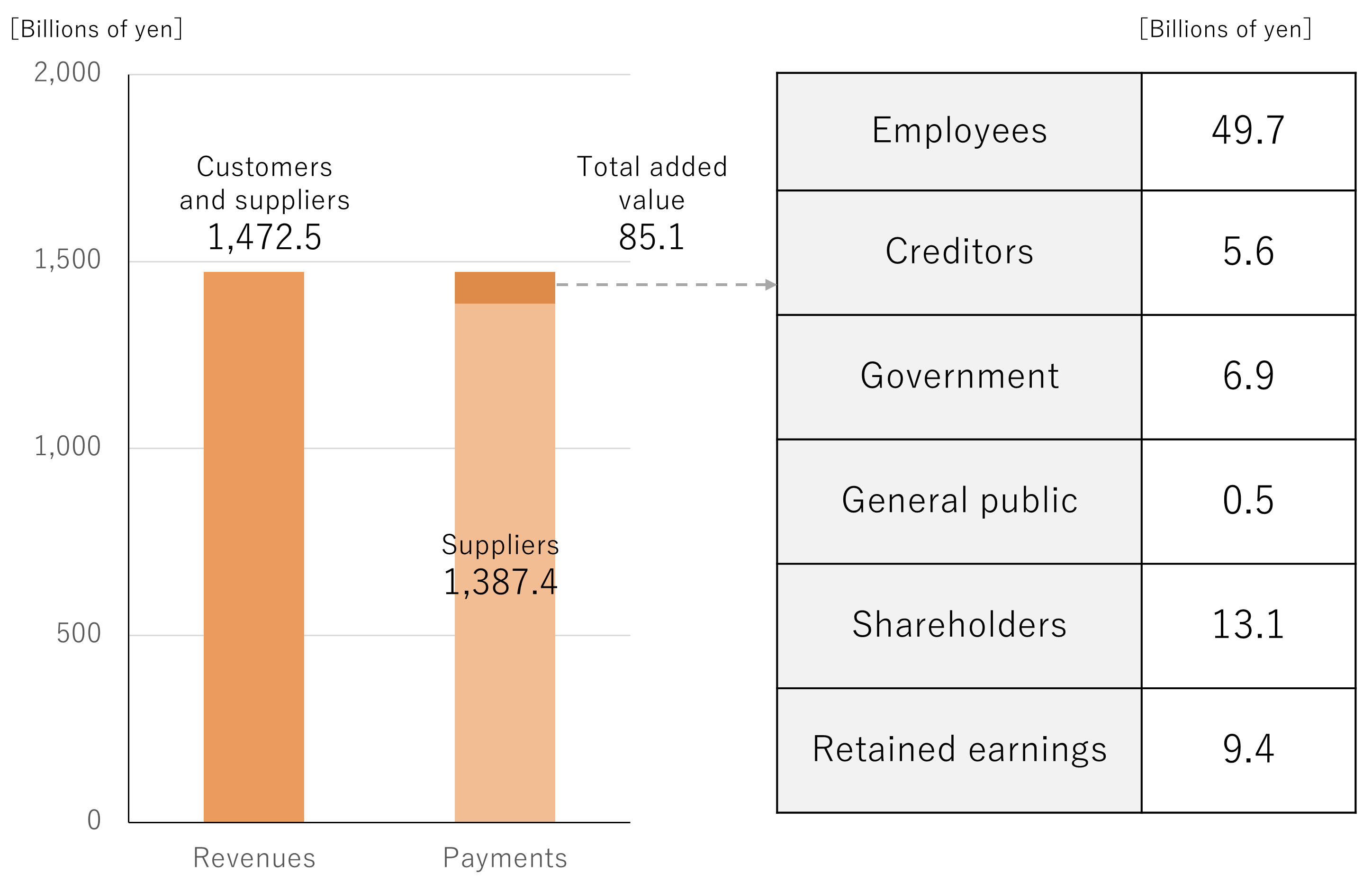
Revenue for Mitsubishi Materials in the fiscal year ended 2026 came to ¥1,472.5 billion. That included proceeds from the sale of products and services, dividends and other forms of non-operating income, and extraordinary income. Operating costs, which consist primarily of payments to suppliers, totaled ¥1,387.4 billion.
After subtracting operating costs from our total revenue, the amount of added value generated through our business activities came to ¥85.1 billion.
Personnel costs, which include statutory welfare expenses and retirement benefit costs contributions and represent the portion of revenue distributed to our employees, came to \49.7 billion.
In the meantime, we distributed a total of \5.6 billion to financial institutions and other creditors, in the form of interest on borrowings. We distribute value to society and local communities through the government and through our own social contribution activities. We paid \6.9 billion to the government this year, as the combined total of corporate income tax plus other taxes and public charges liable as expenses. We also gave \0.5 billion back to the community in the form of social contribution activities, including donations, lending our facilities to the public, and providing employees’ services, in the three fields of the promotion of local environmental protection and conservation activities, supporting next-generation education and diversity and inclusion, and coexistence with local communities under our Community Contribution Activity Policy.
Cash dividends, which represent the value that we distribute to our shareholders (companies and individuals, in Japan and overseas), came to a total of \13.1 billion.
Retained earnings to cover investment and contingencies for the future meanwhile decreased \9.4 billion.
|
Category |
Stakeholder |
Amount (millions of yen) |
Details/method of calculation |
|
Revenues |
Customers and suppliers |
1,472,504 |
Net sales, non-operating income, extraordinary income |
|
Payments |
Suppliers |
1,387,362 |
Operating costs (cost of sales and selling, general and administrative costs, minus deductions for personnel costs, tax and public charges, and donations) |
|
Employees |
49,683 |
Personnel costs (including statutory welfare expenses and retirement benefit expenses) |
|
|
Creditors |
5,599 |
Interest expense |
|
|
Government |
6,896 |
Taxes (corporate income tax, and other taxes and public charges liable as expenses) |
|
|
General public |
514 |
Donations, etc.* |
|
|
Shareholders |
13,084 |
Cash dividends paid |
|
|
Retained earnings |
9,365 |
Net income minus cash dividends paid |
- Amounts less than ¥0.1 billion are rounded.
- Calculated based on the value of items such as donated goods, public lending of our facilities and the provision of employees’ services as well as cash donations, as specified by Nippon Keidanren.
Whenever we engage in business activities overseas, we make every effort to understand conditions in each country and the national identity of its people, placing an emphasis on engaging in activities as a member of the local community. In addition, we re-invest revenue earned from our overseas operations back into the local community wherever possible, in order to continue growing our business and contribute to the sustainable development of the local area.
Obligations relating to unfunded lump-sum severance payment plans and funded defined benefit pension plans totaled ¥23.2 billion and ¥31.7 billion respectively. ¥75.5 billion of this total was paid out in the form of pension assets to outside funds (coverage: 137.5%). In addition, ¥-1.2 billion was recorded as a prepaid pension costs, with the remaining amount of ¥-19.4 billion classed as unrecognized benefit obligations. We plan to amortize all unrecognized benefit obligations over the next ten years. Unrecognized retirement benefit liabilities are mainly posted as expenses based on the straight-line method for a 10-year period.
We received the amount of ¥0.1 billion in grants, subsidies and other financial assistance from the government. The government does not hold shares in Mitsubishi Materials or any of our Group companies.