




Commitment from Top Management
Grounded in “Genba-ryoku,” take personal ownership to implement change with “ambition and passion.”
In the year since I became CEO, I have based my management decisions on our core strengths, “Genba-ryoku,” and the ambition and passion of each and every employee. I myself have learned the importance of accumulating skills and knowledge on the frontline and continuing to refine them. “Genba-ryoku” is the ability to implement change through daily improvements and the accumulation of technology and knowledge.
In order to connect to future growth, we need to review our business portfolio and move forward with efforts to nurture the seeds of new growth. Over the past 10 years, we have streamlined our portfolio by divesting businesses such as cement, sintered parts, and aluminum. Moving forward, we must patiently nurture the seeds of future growth and build an earnings base that is less susceptible to changes in the business environment. Therefore, I would like to continue to create and provide products and services that exceed customer expectations, in other words, create “New Materials.”
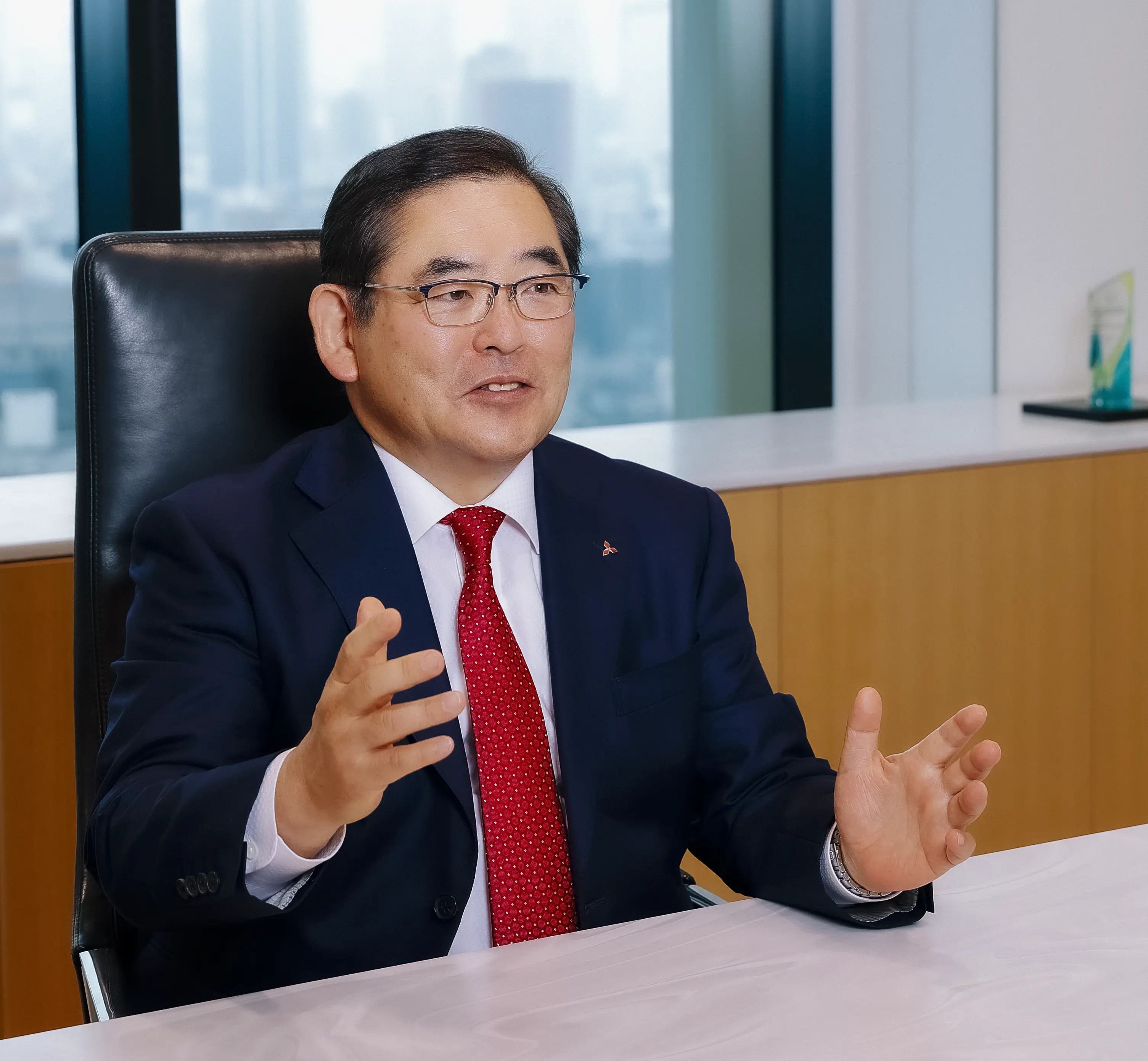
No matter how great a strategy is, it cannot be achieved without strong ambition and passion. I consider it my role to embody this idea, and have continued to emphasize to each and every employee the importance of continuing to take on challenges. This is because I believe that rather than wait for someone else to drive change, we must link goals to our own individual actions, taking charge to turn our “Genba-ryoku” into true competitive edge.
In our Medium-term Management Strategy for the fiscal years ending March 2027 to 2029, we have set out to transform into a company that is “creating the future through resource circulation.” In view of limiting factors, namely our dependence on ores and the increasing demand for metal resources, we will utilize our technological capabilities to steer toward circular growth. What moves difficult change forward is not the strategy itself, but the ability of each individual to accept their own role and act with ambition and passion. I believe that taking personal ownership is what will lead us to a brighter future.
We will not rest on success driven by favorable tailwinds. We cannot simply be satisfied with the current results.
Looking at the figures, we largely achieved the targets set in the previous Medium-term Management Strategy. However, I am not content with the outcome.
This is because our performance was heavily bolstered by external tailwinds, such as the weak yen and rising copper prices. If we measure these metrics strictly against the assumptions underlying the creation of the previous Medium-term Management Strategy, we actually fell short of our goals. Changes in the external environment—such as historically low treatment and refining charges (TC/RCs) for copper concentrate and resource export restrictions linked to geopolitical risks—are unfolding at a pace far exceeding our initial projections. That is precisely why we must accelerate our shift toward a business structure that is resilient to market
and currency fluctuations. It is management’s responsibility to restructure our earnings base proactively, rather than using environmental changes as an excuse. How can we build an “autonomous earning capability” that remains unaffected by external factors? The true value of this approach is currently being put to the test.
To bridge the future supply-demand gap for copper resources and become a key player in a recycling-oriented society.
In our Medium-term Management Strategy for the fiscal years ending March 2027 to 2029, we have set out to transform into a company that is “creating the future through resource circulation.”
While global copper resources are dwindling, demand for copper is projected to rise due to the expansion of the xEV, AI, and data center markets. As limits to ore-based supply become apparent, securing a stable supply of resources and establishing circular systems have become critical challenges for society as a whole. We believe we can contribute by leveraging the smelting and recycling technologies and resource circulation networks we have cultivated over the years. The foundation for this lies in our world-class E-Scrap* processing capacity and highly efficient E-Scrap processing technology, supported by the Mitsubishi Process for continuous copper smelting and our extensive global network. Our strengths in resource circulation extend beyond copper to include tungsten as well. Tungsten, a primary raw material for cemented carbide tools, is currently affected by global supply issues driven by rising geopolitical risks. We have established a circular loop to recover tungsten from used cemented carbide tools, striving to achieve both the effective use of resources and a stable supply.
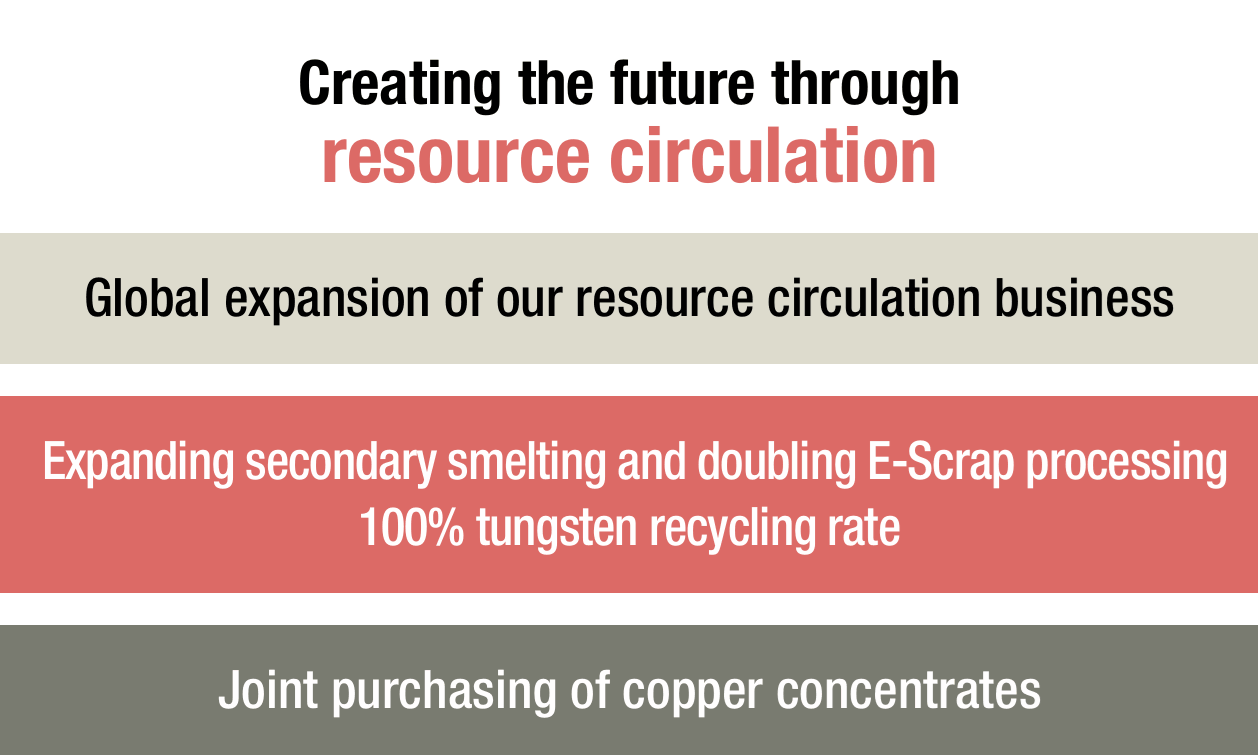
It is about more than simply supplying materials—it is about designing the very mechanisms that enable resource circulation. By implementing these systems in the real world as a core part of our business, we aim to simultaneously ensure stable supply and enhance corporate value. We are convinced that this represents the medium- to long-term role Mitsubishi Materials must fulfill and constitutes our unique, unrivaled value.
- A collective term for discarded circuit boards of electronic devices that contain high concentrations of valuable metals
We aim to create our next driver of growth, “New Materials,” by restructuring our portfolio.
Our fundamental structural reforms are proceeding steadily, and we are now entering a critical phase. We have already moved into the concrete execution stage. We are streamlining corporate support functions, reorganizing sites and business divisions, and reviewing low-profit areas, and are making headway toward results. When reviewing our business portfolio, we prioritize three key factors: whether a business contributes to our transformation into a company that is “creating the future through resource circulation”; whether it has the potential to create “New Materials” (our next growth driver); and whether it leads to enhanced corporate value over the medium- to long-term. At times, this entails the painful decision to withdraw from business we have long prioritized, but this, too, is an essential process for concentrating limited management resources on growth areas. What matters most is ensuring that reform is not a one-off endeavor, but rather a continuous process of refining our business portfolio with a focus on both capital efficiency and growth potential. ROIC-based management serves as the guiding principle for such decisions. I view ROIC not merely as a numerical target, but as a management tool to determine whether each business is generating value that exceeds its cost of capital. With a constant focus on the spread versus WACC (Weighted Average Cost of Capital), we will clarify priorities regarding investments, exits, and restructuring, and rigorously allocate resources to drive the enhancement of corporate value. By optimizing our organizational structure and creating an environment where the capabilities and insights of our frontline teams are fully leveraged, we will dramatically accelerate the pace of our transformation.
A company that continuously creates new value from a core of resource circulation.
Ten years from now, Mitsubishi Materials aims to be more than just a supplier of materials; we aspire to be a company that supports the very systems enabling resource circulation. While constraints on ore-derived resources are intensifying, the demand for metal resources continues to rise due to trends such as electrification and the expansion of AI and data centers. In such times, the market demands companies capable of balancing stable supply with environmental responsibility. We position resource circulation business at the core of our growth by leveraging our world-class smelting and recycling technologies, the network we have built for collecting and processing E-Scrap, and our industry-leading tungsten processing capabilities. Our goal is not merely to expand in scale, but to transform our management approach by centering on resource circulation to simultaneously achieve higher value-added operations and improved capital efficiency. Moving beyond the traditional model that relies on primary raw materials, we will implement a circular model that encompasses collection, regeneration, and reuse, evolving into a company that continuously generates value. In doing so, we will achieve a management style that balances economic and social value, ensuring resilience in the face of change and the continuous enhancement of corporate value.
By turning sustainability into a source of competitiveness, centered on resource circulation.
For us, sustainability is not an initiative separate from our core business. We aspire to be a company that is “creating the future through resource circulation,” and this represents a growth strategy rooted in sustainability. We have identified three key themes for our efforts: “promotion of resource circulation,” “enhancement of human capital,” and “strengthening measures to address global environmental issues.”
First, “promotion of resource circulation” is the area most deeply connected to our core business. We must not merely work toward environmental measures—we must achieve a balance between solving social issues and enhancing corporate value through our core business operations. My goal is to transform sustainability from a mere compliance requirement into a business opportunity that drives competitive advantage.
Next, “enhancement of human capital” serves as the foundation for executing our resource circulation growth strategy. We will support value creation through our core business by encouraging every employee to take personal ownership of transformation and by honing their technical expertise and “Genba-ryoku.” At the same time, we will foster a culture that encourages taking on challenges and promote reskilling to enhance our organizational ability to adapt to change.
That said, “strengthening measures to address global environmental issues” involves realities that cannot be overcome by idealism alone. While we can see a path to reducing CO2 emissions to a certain level, the final stage of achieving net zero presents significant challenges from both technological and economic perspectives. That is why it is crucial not to romanticize the issues, but rather to face reality head-on while steadily building up value creation through our core business and implementing effective measures. I aim to evolve into a company that is resilient in the face of change and capable of continuously enhancing corporate value, while balancing economic and social value.
Turn expectation into conviction through dialogue. We are building the future of Mitsubishi Materials together.
Dialogue with Outside Directors and stakeholders offers a valuable opportunity to refine our management. Candid, critical feedback serves as the fuel that accelerates transformation. By sincerely engaging with questions and proposals from diverse perspectives, we gain greater clarity in our management and hone the quality of our decision-making. We are committed to clearly demonstrating to our shareholders and investors how we successfully balance the creation of “economic value” and “social value.” We invite you to look beyond short-term financial results and witness how our medium- to long-term transformation leads to enhanced profitability and corporate value. And to our employees: the “power of our people”—your power—is the driving force behind this transformation. Transformation truly gains momentum when you integrate corporate goals into your own roles and take on challenges with a sense of personal ownership, rather than simply waiting for instruction.
We will steadily advance our transformation into a company that is “creating the future through resource circulation,” and by carefully communicating our progress and achievements through dialogue, we will drive the sustainable enhancement of our corporate value.